
♬ Worship & Praise — Click any song to play
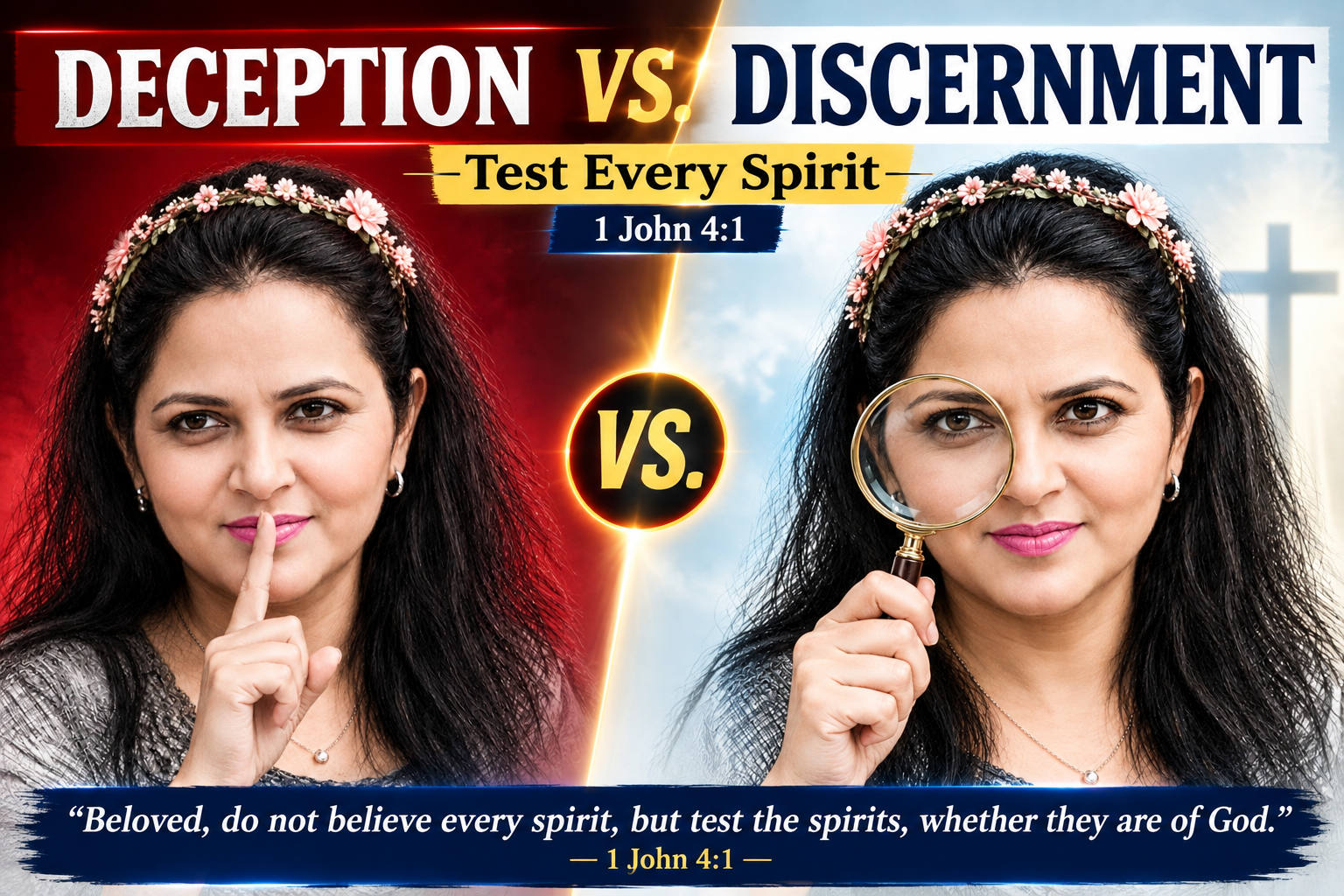
Deception vs Discernment — Test Every Spirit
Point people to God in His word · Inspire holiness
Before we examine what is false, we must first bow before what is true. Jeremiah 17:9 — the heart is deceitful above all things. Psalm 19:12 — who can understand his own errors?
This page on discernment is not written in anger or superiority. It is written in grief — and with trembling — because the standard we apply to others will be applied to us. Matthew 7:2 — with the measure you use it will be measured to you. We hold these truths up not as judges but as fellow believers who love the church and grieve when she is wounded.
⚡ Jump to Any Section
1. All Blessings Purchased at Calvary
The Bible tells us that every spiritual blessing we have comes through Christ. Ephesians 1:3 says that God has blessed us with every spiritual blessing in the heavenly places in Christ.
Our greatest blessings were not earned by human effort. Neither can they be purchased by our wealth, riches, good behaviour, or by trying to please people in spiritual leadership.
Isaiah 53:5 points us to the suffering of Christ. He was wounded for our transgressions and bruised for our iniquities. His suffering was not meaningless. He bore what we could never carry ourselves.
Galatians 3:13 tells us that Christ redeemed us from the curse by becoming a curse for us.
The Holy Spirit does not draw attention away from Jesus and His finished work at Calvary. He leads us into the truth of God's Word and glorifies Christ.
When someone claims to offer a special spiritual blessing, supernatural experience, secret power, or higher level of spirituality, we should not accept the claim simply because it sounds impressive.
Does this point me to Christ and His finished work — or does it make me dependent on a person, experience, or spiritual manifestation?
Calvary is the foundation. Christ is the source. God's Word is our standard.
2. What the Holy Spirit Genuinely Does
Jesus said that the Holy Spirit would glorify Him (John 16:14). The Holy Spirit does not make Himself, a minister, or a ministry the centre. He points people to Jesus.
The Holy Spirit produces fruit such as love, joy, peace, patience, kindness, goodness, faithfulness, gentleness, and self-control (Galatians 5:22-23). He does not need to humiliate people, frighten them, force them, or make them dependent upon a particular minister.
The Holy Spirit is also not opposed to self-control. 1 Corinthians 14:32 shows that spiritual activity does not remove a person's ability to exercise control.
Therefore, when a ministry claims to be operating under the Holy Spirit, we should look beyond dramatic experiences.
Does this glorify Jesus? Does it produce the fruit of the Spirit? Does it honour people's dignity? Does it encourage holiness, truth, gentleness, and self-control?
These are important marks of genuine spiritual ministry.
3. What the Holy Spirit Does NOT Do
God is not the author of confusion, but of peace. "Let all things be done decently and in order." — 1 Corinthians 14:33, 40
This gives us a serious principle for discernment. Can we simply label every strange, chaotic, humiliating, or harmful behaviour "the Holy Spirit"? No.
The Holy Spirit produces self-control and gentleness (Galatians 5:22-23). Therefore, when people are encouraged to behave in ways that are deliberately unruly, when people fall on top of one another, when preventable injuries occur because of a lack of control, or when God's people are made to look like objects of ridicule, we should stop and examine what is happening.
God's kings and priests are not called to become clowns for the entertainment of others.
The Holy Spirit is gentle. Where force is used, where people are physically hurt, emotionally wounded, mentally pressured, frightened, humiliated, or coerced, we have every reason to question the claim that such behaviour is the work of the Holy Spirit. Prayer should never become an excuse for violating someone's physical boundaries.
And the Holy Spirit is pure. Where a minister repeatedly introduces sexual or private body parts into ministry, or touches intimate areas of someone's body under the pretext of prayer, such conduct cannot be justified simply by calling it "anointing" or "the Holy Spirit." The Holy Spirit does not lead people into sexual impurity.
We must never allow a spiritual label to make us ignore behaviour that God's Word tells us to reject.
Does it glorify Christ? Does it reflect the fruit of the Spirit? Does it demonstrate gentleness and self-control? Does it protect people's dignity and purity?
If not, we should not blindly call it the work of the Holy Spirit.
4. Giving as Gratitude — Not Purchase
Jesus told His disciples, "Freely you have received, freely give" (Matthew 10:8). The Gospel and the gifts of God are not products for sale.
In Acts 8:18-20, Simon tried to purchase the power of the Holy Spirit with money. Peter strongly rebuked him. Spiritual authority and the gifts of God cannot be bought.
Christian giving is different. 2 Corinthians 9:7 teaches that each person should give what he has decided in his heart, not reluctantly or under compulsion.
We give because we are grateful to God — not because we are trying to purchase a blessing, miracle, favour, position, prophecy, healing, or spiritual privilege. A genuine ministry should never make people believe that God's blessing has a price tag.
Am I giving freely out of gratitude to God, or am I being persuaded to pay in order to receive something spiritual?
5. Leaders Who Exploit the Vulnerable
God takes the treatment of vulnerable people seriously.
In Ezekiel 34, God confronted shepherds who fed themselves instead of caring for the flock. They used the sheep for their own benefit but failed to strengthen the weak, heal the sick, or seek the lost.
In Nehemiah 5, wealthy people were confronted because their fellow Israelites were suffering under heavy financial burdens.
Leadership is not a licence to take advantage of people. Those who are hurting, frightened, poor, lonely, elderly, or desperate can be especially vulnerable to spiritual pressure. A godly leader should protect people, not exploit their weakness.
Are vulnerable people being cared for — or are their fears, needs, and trust being used for someone else's gain?
6. Wisdom in Lending — Surety and Documents
The Bible does not teach us to abandon wisdom when money is involved.
Scripture repeatedly warns about careless financial commitments. Proverbs 20:16 speaks about taking security when someone becomes surety for another person's debt.
Genesis 38:17-18 also shows that pledges and agreements were matters that had real consequences.
Wisdom means understanding what we are agreeing to before we commit ourselves. Do not sign documents you do not understand. Do not borrow or lend simply because someone uses spiritual language to persuade you. Do not become surety without carefully considering the consequences.
Proverbs 19:19 also reminds us that some consequences follow from our own actions. Faith does not mean switching off wisdom.
Have I understood the financial commitment clearly, considered the consequences, and made the decision freely?
7. Sexual Immorality and Ministry Boundaries
The Bible calls believers to holiness in both public and private life.
Ephesians 5:3-4 tells believers that sexual immorality and impurity should not have a place among God's people.
At the same time, 1 Timothy 5:1-2 gives practical guidance about relationships, teaching younger women to be treated as sisters, with absolute purity.
And 1 Corinthians 6:18 gives a direct command: flee sexual immorality.
Ministry position does not remove the need for boundaries. A spiritual title, anointing, reputation, or position never gives anyone permission to cross sexual or relational boundaries. Healthy ministry should protect purity, dignity, and trust.
Are biblical boundaries being respected — or is spiritual authority being used to justify inappropriate behaviour?
8. The Blesser, Not the Blessing
God's gifts are wonderful, but the Giver is greater than His gifts.
Jesus taught us to seek first the kingdom of God and His righteousness (Matthew 6:33). James 1:17 reminds us that every good and perfect gift comes from above.
We must therefore be careful not to become so focused on blessings that we forget God Himself. Even prosperity, success, health, ministry growth, recognition, or material possessions can become idols if they take God's place in our hearts.
Jesus warned the church in Laodicea about becoming spiritually lukewarm (Revelation 3:15-16).
The genuine work of the Holy Spirit turns our hearts toward God — not merely toward what we can receive from Him.
9. When the Minister Becomes the Message
In Acts 3, after a miracle, people looked at Peter and John with amazement. Peter immediately redirected their attention away from themselves and toward Jesus.
John the Baptist expressed the right attitude clearly: "He must increase, but I must decrease." (John 3:30)
Jesus also warned against leaders who loved titles, honour, and places of recognition (Matthew 23:5-7).
God can use people greatly, but the servant must never replace the Saviour. When a ministry constantly draws attention to the personality, lifestyle, power, possessions, or special status of the minister, we should pause and discern.
Is Jesus becoming greater — or is the minister becoming the centre of attention?
10. Isaiah 5:20 — Calling Evil Good
Isaiah 5:20 gives a serious warning against calling evil good and good evil. God's truth does not change simply because something becomes popular, profitable, or culturally acceptable.
Romans 1:16 reminds us not to be ashamed of the Gospel.
Paul also warned in 2 Timothy 4:3-4 that people would turn away from sound teaching and gather teachers who tell them what they want to hear.
Discernment sometimes means hearing something we do not want to hear.
We must never rename sin as righteousness simply because doing so is easier, more popular, or more profitable.
11. Blood and Leaven
The Bible treats holy things with reverence.
Exodus 23:18 gives instructions concerning blood and leaven in the context of sacrifice. Jesus later used leaven as a picture of corrupting influence, warning His disciples to beware of it (Matthew 16:6).
The Lord's Table is also not something to approach carelessly. In 1 Corinthians 11:27-30, Paul warns believers to examine themselves and recognise the seriousness of the body and blood of the Lord.
The lesson is not that Christians should live in fear. It is that holy things should never be treated casually or used for manipulation.
If you would like to understand this further, see our full teaching on the Lord's Table.
Is this practice helping people honour Christ — or is something holy being used carelessly, commercially, or manipulatively?
12. Recognising Patterns — Not Attacking Persons
Discernment is not the same as attacking people.
The Bible warns us about false teachers and those who use religion for dishonest gain. 2 Peter 2:3 speaks of people who exploit others through greed. 1 Timothy 6:5 warns about people who see godliness as a means of financial gain.
Jesus also taught His disciples to recognise people by their fruit (Matthew 7:15-20). Notice the emphasis: fruit.
We do not need to guess someone's heart or make accusations without evidence. We can observe teachings, actions, repeated patterns, and their results.
Am I examining the teaching and its fruit — or am I attacking a person?
13. How to Test Any Teaching
The Bible does not tell us to believe every spiritual claim.
1 John 4:1 says to test the spirits to see whether they are from God.
The Bereans in Acts 17:11 were commended because they listened carefully and then examined the Scriptures to see whether what they heard was true.
And 1 Thessalonians 5:21 gives us a simple principle: test everything, hold fast to what is good.
This means we should not accept a teaching merely because a famous person teaches it; many people believe it; it sounds supernatural; it produces strong emotions; someone says "God told me"; or it appears successful.
The final standard is God's truth.
Does this teaching agree with Scripture, honour Christ, and produce godly fruit?
14. Leave Judgment to God
Discernment does not give us permission to become judges of people's hearts.
Romans 14:4 asks, "Who are you to judge another's servant?" Verse 12 reminds us that each of us will give an account of ourselves to God.
Paul also says in 1 Corinthians 4:5 that we should not pronounce final judgment before the Lord comes, because He will bring hidden things to light.
We are called to test teaching, recognise fruit, reject what is false, and hold firmly to what is good. But the final judgment belongs to God.
15. The Word Above Every Experience
God has given us His Word as our standard of truth.
2 Timothy 3:16-17 tells us that all Scripture is given by inspiration of God and is useful for teaching, correction, and instruction in righteousness.
This means that Scripture must stand above our feelings, experiences, visions, dreams, signs, wonders, traditions, personalities, and spiritual claims.
A powerful experience does not make something biblical. A large crowd does not make something biblical. A famous minister does not make something biblical. And saying "God told me" does not make something biblical.
Everything must be tested against God's revealed Word. Paul gave an extremely serious warning in Galatians 1:8: even if an angel were to preach a different gospel, that message must be rejected.
Isaiah 8:20 gives us another clear principle: "To the law and to the testimony!"
Therefore, when we encounter any teaching, manifestation, prophecy, spiritual experience, or ministry practice, we should ask: what does Scripture say? Not "How did it make me feel?" Not "How supernatural did it look?" Not "How many people believe it?" But: "Does it agree with the Word of God?"
💍 Discernment Before Marriage
Marriage is a lifelong covenant. Don't ignore character simply because you are attracted to someone, emotionally attached, or impressed by their spirituality.
Watch carefully when a person:
Insults you — especially when angry or in disagreement.
Constantly finds fault with you or your family — rather than showing respect and grace.
Blames you or your family for everything — while refusing to acknowledge their own mistakes.
Deliberately keeps distance from you and your family — while expecting you to become part of their world.
Shows unusual interest in your family's assets, property or finances — particularly early in the relationship.
Demands secrecy from you while freely sharing your private matters with family or friends.
Habitually lies, becomes angry easily, takes offence, seeks constant attention or portrays themselves as the victim.
Is charming with outsiders but cold, disrespectful or harsh toward those closest to them.
Constantly boasts about themselves, their achievements, connections, possessions or spirituality.
Is demanding, controlling or excessively suspicious — and mistakes possessiveness for love.
Is habitually lazy and avoids responsibility — expecting others to carry their share.
Has an unhealthy attitude toward money — whether consistently stingy, recklessly extravagant, secretive or irresponsible.
Is actively involved in church but shows little genuine fear of God in everyday life. Church involvement is not the same as godly character.
Disrespects boundaries — keeps pushing after you have clearly said "no," or treats your boundaries as rejection.
Controls rather than loves — wants to control your clothing, friendships, phone, finances, movements, decisions or relationships with family.
Cannot accept correction — becomes defensive, angry or manipulative whenever someone points out a genuine mistake.
Never apologizes sincerely — says "sorry" only to end an argument, but repeats the same behaviour without change.
Treats service workers, the poor, elderly people or strangers badly — character is often revealed in how someone treats people from whom they have nothing to gain.
Has a different personality in public and private — admired by everyone outside but harsh, humiliating or abusive behind closed doors.
Rushes the relationship or pressures you into marriage — discourages you from taking time to pray, seek counsel or allow families to know one another properly.
Tries to isolate you — gradually turning you against your parents, siblings, friends or anyone who offers wise counsel.
Has unresolved addictions or destructive habits — and minimizes, hides or excuses them rather than seeking genuine help and accountability.
Has no sense of responsibility — repeatedly fails to keep commitments, hold a job, manage money or fulfil ordinary obligations.
Uses Scripture to manipulate you — especially by demanding submission, obedience, forgiveness or secrecy while avoiding their own biblical responsibilities.
Shows no evidence of repentance — keeps saying, "That's just how I am," instead of allowing God to transform their character.
Is sexually pressuring or inappropriate — refuses to honour purity, consent or your convictions.
Despises wise counsel — particularly when several mature, trustworthy people independently notice the same concerning behaviour.
Makes you afraid to be honest — you find yourself constantly walking on eggshells to prevent anger, accusations, withdrawal or punishment.
"By their fruits you will recognize them."
— Matthew 7:16Look beyond words, charm, gifts, ministry, promises and appearances. Observe character, consistency, humility, honesty, responsibility, self-control and how the person treats those who cannot benefit them.
Because chemistry can be strong, words can be beautiful, gifts can be impressive, and even church involvement can be genuine — but marriage exposes character.
💚 A Positive Discernment — What to Look For
Humility, truthfulness, self-control, responsibility, kindness, teachability, faithfulness, respect for parents and boundaries, financial responsibility, and genuine fruit of the Spirit (Galatians 5:22-23).
Father, in Jesus' Name,
Your Word says, "If any of you lacks wisdom, let him ask of God, who gives to all liberally and without reproach." — James 1:5
So I ask You for wisdom and discernment.
"Teach me good judgment and knowledge." — Psalm 119:66
Give me spiritual eyes to see beyond appearances, words and circumstances. Help me recognize what is from You and what is not. Keep me from being deceived by charm, emotions, fear, pressure or outward appearances.
Your Word says, "Test all things; hold fast what is good." — 1 Thessalonians 5:21
Therefore, help me test everything according to Your Word and hold firmly to what is good. Expose what needs to be exposed, reveal what needs to be revealed, and give me the courage to walk away from anything that is not Your will.
I believe that You are giving me wisdom, discernment and understanding, and that You are guiding my steps according to Your perfect will.
In Jesus' Name, Amen.
Don't Let Anyone Make Sin Sound Safe
Before You Believe It, Discern It
Deception rarely arrives saying "Hello, I'm deception." It often arrives sounding confident, compassionate, popular, reasonable — even biblical. When someone says:
"Everyone does it." · "Just once won't hurt." · "Don't worry — God will forgive you." · "The Bible says it's okay." · "Even Christians do it." · "You don't need to tell anyone." · "Trust me."
And then ask: "Does this draw me closer to Christ — or give me an excuse to disobey Him?"
⚡ Jump to Any Section
A. The Deceptive Phrases You'll Hear
Children and teenagers today may hear statements such as: "Do it once, you'll love it." "If you don't, you're a loser." "There's no harm in trying it once." "We have to explore everything." "Everyone lies — didn't you ever lie?" "God is merciful, He forgives." "Only blasphemy against the Holy Spirit is unforgivable — every other sin is pardonable." "Even great preachers do it." "We're only human." "We have only one life, we should enjoy it."
These statements may sound reassuring, tolerant, or even religious — but they can contain serious errors in reasoning and dangerous misuse of Scripture.
B. "Just Once" and Peer Pressure Aren't Arguments
"Just once" is often used to make a serious decision sound insignificant. But some choices have consequences that cannot simply be undone. The wise person doesn't only ask "Can I try it?" — they also ask: where could this lead me? Could this harm me or someone else? Could it weaken my conscience or become a habit? Would I be comfortable doing this if Jesus were physically standing beside me?
"If you don't, you're a loser." "Everyone else is doing it." These are not reasons — they are pressure and manipulation. A person who genuinely cares about you will allow you to think, ask questions, say no, and walk away.
C. "We Have to Explore Everything" Isn't Wisdom
Curiosity is not evil. Learning is good. But Scripture never teaches that we must personally experience every form of evil before we're allowed to reject it. We can learn about something without participating in it, and understand temptation without surrendering to it.
D. The Bible Records Sin — It Doesn't Endorse It
Abraham lied. Isaac lied. David committed adultery and arranged for Uriah's death. Solomon had 700 wives and 300 concubines, and Scripture specifically says his wives turned his heart away from God (1 Kings 11:3-4). The Bible records these events honestly — but that honest record is not God's endorsement of the sin.
E. Someone Else's Sin Isn't Permission for Yours
"Everyone lies." "Didn't you ever lie?" These statements change the question. The real question isn't "does anyone ever lie" — it's "does God approve of lying?" Even if everyone around you were doing something wrong, it would still be wrong.
Biblical discernment asks: "What does God say" — not "what does everybody else do?"
F. God's Mercy Is Not Permission to Sin
Yes, God is merciful. Yes, David was forgiven. But God's forgiveness didn't make David's adultery and murder suddenly good — he still experienced serious consequences. Someone may also quote "there is therefore now no condemnation to those who are in Christ Jesus" (Romans 8:1) and twist it into "therefore I can do whatever I want." But that same chapter teaches believers to live according to the Spirit, not the flesh.
Jesus warned that only blasphemy against the Holy Spirit is unforgivable. That truth must never become "every other sin is safe because God will forgive it" — that is presumption, not faith.
G. Don't Judge Right and Wrong by Other People's Behaviour
"Even great preachers do it." "Great preachers steal from their offerings, why can't we?" The answer is simple: our standard is not another person's behaviour — it is God's Word. A famous person, a respected preacher, a parent, a teacher, a church leader — all can be wrong. That is why Scripture tells us to test what we hear (1 John 4:1).
"We can't be perfect, only God is perfect" is true — but it doesn't mean we stop pursuing holiness. "We're only human" explains our need for grace; it doesn't explain away disobedience. Jesus Himself was tempted in every way, yet did not sin (Hebrews 4:15).
"We have only one life, we should enjoy it" is also true — our choices matter precisely because life is short (Psalm 90:12), not because anything goes. And "we just need to ensure protection" confuses two separate questions: is this physically safe, and is this spiritually and morally right? Reducing a physical risk does not make an action morally right.
H. When Satan Himself Quotes Scripture
One of the strongest lessons in discernment comes from the temptation of Jesus (Matthew 4:1-11). Hearing someone quote the Bible does not automatically mean what they are saying is biblical — because Satan quoted Scripture too.
Temptation 1 — Stones into bread. Satan appealed to a genuine need: Jesus was hungry. Jesus answered, "Man shall not live by bread alone, but by every word that proceeds from the mouth of God" (Deuteronomy 8:3). The lesson: a legitimate need does not justify disobeying God.
Temptation 2 — Jump from the temple. Satan quoted Psalm 91:11-12 — a true promise of God's protection — and twisted it into "prove it, jump." Jesus answered, "You shall not tempt the LORD your God" (Deuteronomy 6:16). He didn't deny the verse — He refused the false conclusion drawn from it. A verse can be true while the conclusion someone draws from it is false.
Temptation 3 — Worship Satan for the kingdoms of the world. An extremely desirable outcome does not justify disobedience. Jesus answered, "You shall worship the LORD your God, and Him only you shall serve" (Deuteronomy 6:13).
1. Take a legitimate desire or vulnerability. 2. Add pressure. 3. Twist or misuse God's Word. 4. Make disobedience sound reasonable. 5. Offer an apparently attractive result.
Know God's Word. Understand God's Word. Use God's Word correctly. Refuse to compromise. Obey God rather than the tempting voice.
I. Don't Let Feelings Become Your Interpreter of Scripture
"I really want this, therefore God must be okay with it." "I don't feel guilty, therefore it can't be wrong." "God wouldn't want me to be unhappy, therefore this must be His will." Feelings are real without necessarily being reliable guides to truth.
J. Guard What You Study, See & Feed Your Mind
Study the whole Word. A single verse can be misunderstood when isolated from its context, audience and purpose. The Bereans were commended because they didn't simply accept what they heard — they examined the Scriptures for themselves (Acts 17:11).
Choose your influences carefully. Psalm 1 gives a progression: walk → stand → sit. What begins as listening can gradually become acceptance, participation, and finally identification.
Guard your eyes. Job said, "I have made a covenant with my eyes" (Job 31:1). Eve saw that the fruit was pleasing to the eye, desirable — then she took it (Genesis 3). We can't always control what suddenly appears before us, but we can choose whether to keep looking. What repeatedly fills our eyes can begin to fill our thoughts; what fills our thoughts influences our desires; our desires influence our choices.
Watch for the danger of repeated exposure. The first encounter with something wrong often produces "that's wrong." After repeated exposure: "everyone does that." Then: "it's normal." Eventually: "what's wrong with it?" Repeated exposure through entertainment, social media and conversation can gradually normalize what once shocked the conscience.
What we feed our minds matters.
K. Talk to Trusted Counsel & Ask Who Benefits
When something feels confusing, frightening, exciting, or spiritually complicated, you don't have to solve it alone. Talk to a godly parent, mature Christian, trusted pastor, or biblically sound elder.
Not every counsellor is wise simply because they are older — choose people whose lives and counsel are consistent with Scripture.
Ask who benefits from this advice. Who benefits if I believe this? What happens if I say no? Are they respecting my boundaries? Are they discouraging me from talking to my parents or trusted Christian adults? Are they telling me to keep secrets? Are they making me feel ashamed for wanting to obey God? These questions can expose manipulation.
L. Temptation Is Not the Same as Sin
Jesus was tempted, yet He did not sin. A sinful thought may enter our mind without being something we deliberately choose to cultivate.
M. The Five-Question Test & Red Flag Checklist
Before accepting advice, especially about morality, relationships, money, truthfulness, or entertainment, ask:
- What does God's Word actually say?
- Is this verse being used in context?
- Does this teaching agree with the rest of Scripture?
- Is this person encouraging me toward holiness — or giving me reasons to ignore God's commands?
- Would I be comfortable discussing this advice openly with a trusted, God-fearing adult?
🚩 STOP when someone says: "Everyone does it." "Just once." "Don't be a loser." "If you loved me, you would." "You have to try it to know." "Don't tell your parents." "Don't tell anyone at church." "God will forgive you anyway." "The Bible says it's okay." "Even great preachers do it." "You're already forgiven, so it doesn't matter."
"Don't let someone else's confidence replace your discernment."
N. For Younger Children — Simple Tools
When You're Not Sure, Remember:
Five simple questions for young children: 1. Is it true — does this agree with God's Word? 2. Is it good — would this please God? 3. Why are they asking me to do it — are they helping me or pressuring me? 4. What could happen next? 5. Who can I ask — can I talk to Mum, Dad, or another trusted adult?
A simple rule for little hearts: Don't believe everything you hear. Don't do everything everyone else does. Don't keep looking at things that make wrong look right. Don't let anyone tell you to keep a secret from safe, trusted parents. When you're confused, STOP and ASK. God's Word is our guide.
For parents: when your child hears "everyone else is doing it," ask "does everyone doing something make it right?" When they hear "just try it once," ask "should we do something just because someone tells us to?" When they hear "the Bible says...", ask "shall we open the Bible and see what it really says?" When your child sees something inappropriate: "you don't have to keep looking — you can look away and come to me." When your child makes a mistake: "you can always tell me the truth — we can bring our mistakes to God together."
O. Discernment Is Not Suspicion
Biblical discernment does not mean believing everyone is trying to deceive you, judging people's hearts, or becoming proud because you think you know better than everyone else. It means learning to recognize truth and reject falsehood while remaining humble, loving, and teachable.
We can love people while rejecting false teaching. We can disagree without mocking. We can correct without becoming arrogant. And we can say, "I don't know — let me check God's Word and ask someone wise." That is not weakness. That is wisdom.
📘 How to Use This Discernment Guide
For parents, for teens, and for anyone ready to pass it on
👨👩👧 For Parents
Don't wait until your child faces a difficult situation to teach discernment. Read this guide together when your child is young. Choose one principle at a time, discuss real-life examples, read the Scriptures in context, and invite your child to ask questions — even difficult ones.
Don't simply teach your child "don't do this." Teach them to ask: "What does God's Word say?" "Is this being presented truthfully?" "Is Scripture being used in context?" "Who is trying to influence me — and why?" "What could happen if I follow this advice?"
Most importantly, create a home where your child knows: "You can always come to me with a question. You will not be shamed for asking."
🧑 For Teens
Don't merely read this page once. Use it as a discernment exercise. When you hear a statement that sounds convincing, stop and examine it. Look up the Scripture. Read the verses before and after it. Compare it with other passages. Pray. Think about the consequences. Then discuss it with a mature, God-fearing Christian whom you trust.
You are responsible before God for what you believe and how you live.
🌱 Teach Others
Once you understand these principles, teach them to younger siblings, friends, youth groups, Bible-study groups, or other young people.
Don't use discernment to judge or mock people. Use it to recognize truth, resist deception, protect one another, and point people back to God's Word.
Learn it. Live it. Share it.
Heavenly Father,
Thank You that You are the source of all wisdom and truth.
Please give me a heart that loves what is good and recognizes what is false. Give me discernment when I hear advice, opinions, teaching, or even Scripture being quoted.
Help me never to believe something simply because it sounds convincing, because everyone else believes it, or because someone I respect says it.
Teach me to know Your Word, understand it correctly, and live according to it.
When I am tempted, give me the strength to say no. When I am confused, help me seek wise and God-fearing counsel. When someone pressures, shames, flatters, frightens, or manipulates me, give me courage to recognize it and walk away.
Protect me from deception, but also protect me from becoming proud, suspicious, or judgmental. Give me humility to admit when I am wrong and courage to stand for what is right.
Please surround me with people who will encourage me to love You, obey Your Word, and grow in holiness.
And Father, make me a godly influence too. Help me use my words, choices, friendships, and example to lead others toward truth rather than temptation; toward wisdom rather than foolishness; toward Christ rather than the ways of the world.
May my life point others to Jesus.
"If any of you lacks wisdom, let him ask of God..." — James 1:5
In Jesus' name, Amen.
This teaching is intended to encourage biblical discernment and to help readers examine spiritual teachings, practices, and claims in the light of God's Word. It is not intended to attack, condemn, or make personal accusations against any individual, minister, church, or ministry.
We are called to "test the spirits" (1 John 4:1), examine the fruit (Matthew 7:15-20), and hold fast to what is good (1 Thessalonians 5:21). At the same time, final judgment belongs to God.
Readers are encouraged to study the Scriptures carefully, pray for wisdom, and seek appropriate pastoral, legal, or professional advice where necessary.
Website Copyright Notice — Applicable to All Content on charlenz.shop
© Joyce Braganza · Tree of Life Deliverance Ministry · charlenz.shop · All Rights Reserved.
All content on this website — including Bible studies, games, quizzes, prayers, praises, prophecies, family trees, concordances, devotionals, articles, books, downloads, graphics, illustrations, designs, calendars, planners, templates and all written material — is the intellectual property of Joyce Braganza and Tree of Life Deliverance Ministry, unless otherwise stated. This content is made available solely for personal, non-commercial and devotional use only.
🚫 Not permitted without prior written permission: Copying . Reproduction · Redistribution · Republication · Sale · Commercial use · Adaptation · Translation · AI training · Data scraping · Digital storage for redistribution · Publication in any format · Distribution via any medium.
Unauthorized reproduction, distribution, republication, adaptation, or commercial use of any part of this website may constitute copyright infringement and may result in legal action.
✅ Permitted: Personal reading · Sharing the page URL · Printing for personal use · Brief quotations with full attribution to charlenz.shop.
📧 For permissions, translations or print enquiries: ask@charlenz.shop ·
"A faithful person will be richly blessed." — Proverbs 28:20 ✝️