
♬ Worship & Praise — Click any song to play
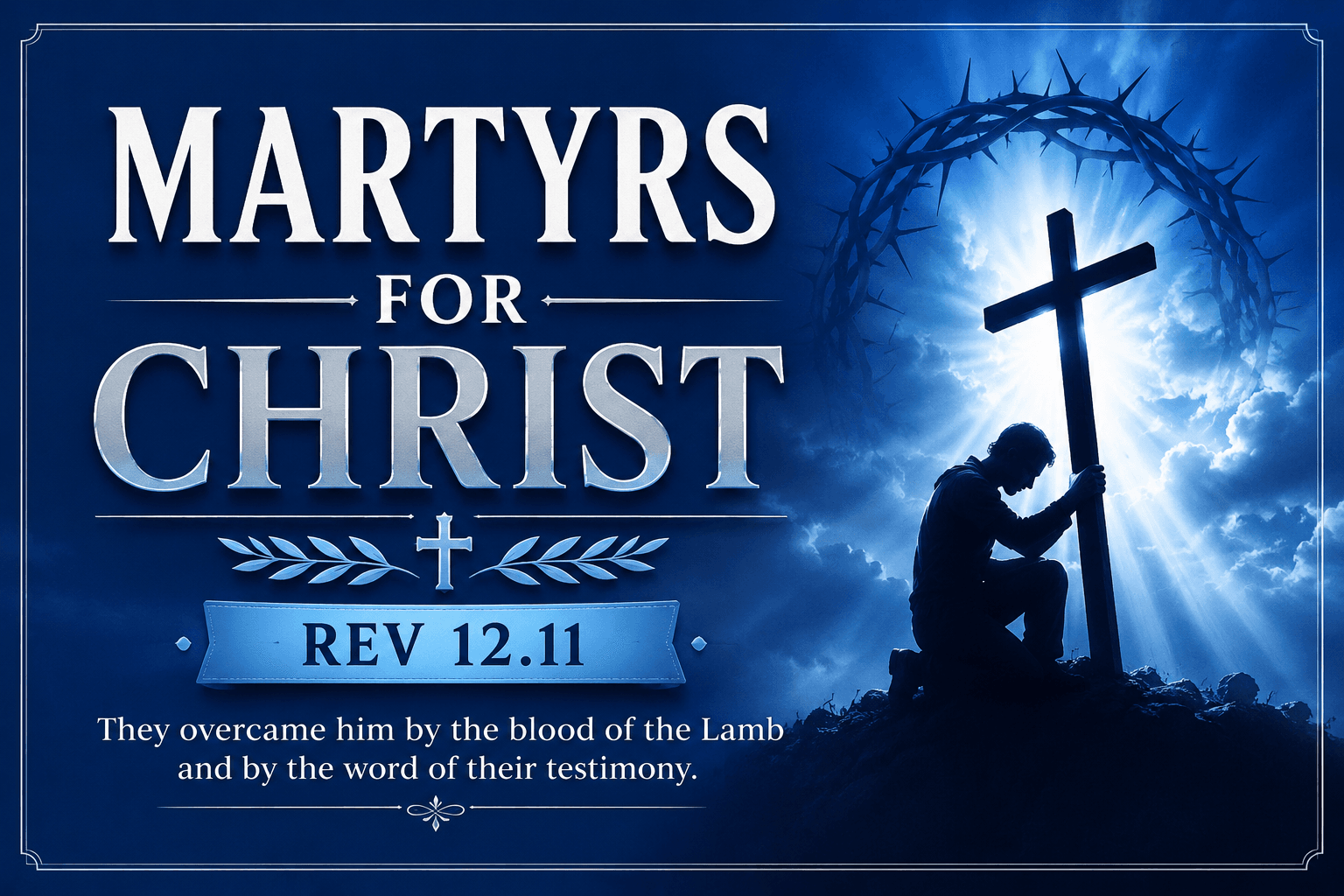
Martyrs for Christ
They gave what they could not keep to gain what they could not lose. Their blood is the seed of the church.
A martyr is a witness — the Greek word martyrs means witness. These men and women witnessed to the truth of Jesus Christ at the cost of their lives. They did not die as heroes seeking glory. They died as ordinary people who found that Jesus was worth more than life itself.
For biblical martyrs — Stephen, James, Paul, Peter and others — please visit the Bible People & Places page on charlenz.shop. This page honours those who gave their lives for Christ outside the pages of Scripture. ✝️
📌 More names are coming. We are waiting for responses from organisations working with the persecuted church regarding Indian, Pakistani and Nigerian martyrs. Their entries will be added when confirmed. If you know of a documented martyr who should be on this page, write to ask@charlenz.shop.
⚡ Jump to Any Martyr
Polycarp
Polycarp was Bishop of Smyrna and a direct disciple of the apostle John. He lived in the generation that bridged the apostolic age and the early church — a living link between the eyewitnesses of Christ and the next generation of believers. He was known for his gentleness, his faithfulness to apostolic teaching and his care for his congregation across a long ministry. Ignatius of Antioch, himself a martyr, wrote letters to Polycarp urging him to stand firm.
In 155 AD, during a period of persecution, Roman authorities arrested Polycarp and demanded he publicly deny Christ. He was brought to the stadium before a crowd. The proconsul urged him to swear by Caesar, to renounce Christ and to go free. Polycarp refused. He was sentenced to be burned. Eyewitnesses recorded that the flames formed an arch around him like a ship's sail and that he was not consumed by them. He was finally stabbed. He was approximately eighty-six years old.
When the proconsul demanded he deny Christ and said "Swear by Caesar and I will release you — reproach Christ," Polycarp replied: "Eighty-six years I have served Him and He has done me no wrong. How can I blaspheme my King who saved me?" He then prayed aloud giving thanks to God for counting him worthy to share in the cup of Christ's sufferings.
Polycarp's martyrdom is one of the earliest and best-documented accounts of Christian martyrdom outside the New Testament. The letter written by the church at Smyrna describing his death — the Martyrdom of Polycarp — is the oldest detailed account of a Christian martyrdom and became a model for how the early church honoured its martyrs. He demonstrated that faithfulness to Christ is not an abstraction — it is a commitment tested in the most concrete possible way.
"Eighty-six years I have served Him and He has done me no wrong. How can I blaspheme my King who saved me?"
Vibia Perpetua and Felicitas
Vibia Perpetua was a young noblewoman of about twenty-two, well-educated and nursing an infant son, when she was arrested in Carthage under Emperor Septimius Severus for being a Christian. Felicitas was her slave, eight months pregnant at the time of arrest. Despite coming from completely different social positions — one noble, one a slave — they faced death together with equal courage. Perpetua kept a diary in prison that has survived to this day, making it one of the earliest texts written by a Christian woman.
They were condemned to face wild beasts in the arena as public entertainment. Felicitas gave birth in prison two days before the execution — her fellow prisoners were concerned she might not be permitted to die with them since Roman law forbade executing pregnant women. She delivered and the baby was adopted by a Christian woman. In the arena Perpetua was reported to have guided the trembling hand of her executioner to her own throat, having been wounded but not killed by the animals. Both died on March 7, 203 AD.
When her father pleaded with her to recant for the sake of her infant son, Perpetua pointed to a water vessel and asked: "Can that vessel change its name?" He said no. She replied: "Neither can I call myself anything other than what I am — a Christian." In her diary she wrote: "I was in the Spirit and I saw a golden ladder reaching to heaven."
The Passion of Perpetua and Felicitas is one of the most significant documents of early Christianity. Their story has been read, celebrated and drawn upon by the church for nearly two thousand years. They demonstrated that neither social position, nor family ties, nor motherhood, nor any earthly bond could outweigh the worth of Christ. The church formally commemorates them on March 7 each year.
"I cannot call myself anything other than what I am — a Christian."
John Hus
John Hus was a Czech priest, philosopher and rector of the University of Prague who became one of the earliest and most significant voices for church reform — a century before Martin Luther. Influenced by the writings of John Wycliffe, he preached against the corruption of the clergy, the selling of indulgences and the authority of Scripture over church tradition. His preaching drew huge crowds and made him enormously influential in Bohemia while making him deeply dangerous enemies in Rome.
Hus was summoned to the Council of Constance in 1414 under a guarantee of safe conduct from Emperor Sigismund. The guarantee was broken. He was arrested, tried for heresy and given the opportunity to recant. He refused to recant teachings he believed were grounded in Scripture unless shown from Scripture that he was wrong. On July 6, 1415 he was burned at the stake. He sang hymns as the flames rose.
Before the council he said: "I would not for a chapel of gold retreat from the truth." As the fire was lit he prayed: "Lord Jesus, it is for thee that I patiently endure this cruel death. I pray thee to have mercy on my enemies." Before his death he reportedly said: "You are now going to burn a goose — but in a century you will have a swan which you can neither roast nor boil." Many took this as prophetic of Martin Luther, who was born sixty-six years later.
Martin Luther said he was a Hussite without knowing it — Hus's theology anticipated the Reformation by a century. His death sparked the Hussite Wars in Bohemia and his influence on the Czech national identity has been profound for six centuries. The Moravian Brethren — one of the most significant missionary movements in church history — traces its origins directly to the community formed around Hus's teaching.
"I would not for a chapel of gold retreat from the truth."
William Tyndale
William Tyndale was a scholar and linguist who mastered seven languages and became convinced that the greatest need of the English church was a Bible people could read in their own language. The Latin Vulgate was inaccessible to ordinary people and clergy were not required to read it in English. When Tyndale sought permission from the Bishop of London to translate the Bible into English, he was refused. He went to continental Europe and worked in exile, completing the New Testament in English in 1526 and substantial portions of the Old Testament before his capture.
Tyndale was betrayed by a man he trusted, arrested in Antwerp in 1535 and imprisoned in Vilvoorde Castle for over a year. He was tried for heresy, convicted and on October 6, 1536 was strangled at the stake and then burned. He was approximately forty-two years old.
His last recorded words at the stake were a prayer spoken with great fervour: "Lord, open the King of England's eyes." Within less than two years of his death, an English Bible was authorised by King Henry VIII. The prayer was answered almost immediately. Much of the King James Bible of 1611 is directly built on Tyndale's translation — scholars estimate that eighty-three percent of the New Testament in the KJV is Tyndale's words.
Tyndale's translation gave the English language phrases that are still used daily — "let there be light," "the powers that be," "a moment in time," "fight the good fight." His work ensured that every English-speaking person who has ever read the Bible has been shaped by his scholarship. He paid for that work with his life. His dying prayer for the King's eyes to be opened was answered before his body was cold.
"Lord, open the King of England's eyes."
Jim Elliot and Four Companions
In January 1956 five young American missionaries attempted to make peaceful contact with the Waodani people (then called the Auca) of Ecuador — a tribe that had killed every outsider who had entered their territory. Jim Elliot, Nate Saint, Roger Youderian, Ed McCully and Pete Fleming had spent months preparing carefully — dropping gifts from their plane, learning phrases from the language, making friendly contact from the air. On January 3, 1956 they landed on a sandbar they called Palm Beach and made initial friendly contact. Four days later all five were killed with spears.
On January 8, 1956 the five men were attacked and killed on the sandbar. They were all in their late twenties and early thirties. They carried guns but did not fire them — they had agreed beforehand that they would not shoot the Waodani since they were prepared to die and the Waodani were not. Their bodies were found in the river. News of their deaths made the front page of Life magazine and shocked the world.
Jim Elliot's journal, kept for years before his death, contained the line that has outlasted him by decades: "He is no fool who gives what he cannot keep to gain what he cannot lose." Nate Saint wrote before the operation: "As we weigh the future and seek the will of God, does it seem right that we should hazard our lives for just a few savages?" He answered himself: "Those fellows are not savages. They are in need of the gospel." His sister Rachel Saint and Jim Elliot's wife Elisabeth Elliot later returned to the Waodani. Most of the tribe — including the men who killed the five — came to faith in Christ.
The story of the five missionaries transformed a generation of young Christians worldwide. Elisabeth Elliot's book Through Gates of Splendour has never gone out of print. Rachel Saint spent the rest of her life with the Waodani. The tribe that killed five missionaries became a community of believers who sent their own members as missionaries to other tribes. The blood of the martyrs became the seed of the church — literally and specifically in this case.
"He is no fool who gives what he cannot keep to gain what he cannot lose."
Graham Staines and His Sons Philip and Timothy
Graham Staines was an Australian missionary who came to India in 1965 and spent thirty-four years working with leprosy patients in Odisha — some of the most marginalised and stigmatised people in Indian society. He lived simply, learned the local language and culture and gave his life to people others had written off. He married Gladys and they had three children — Esther, Philip and Timothy. He was deeply loved by the communities he served.
On the night of January 22-23, 1999 Graham was sleeping in his vehicle with his two sons Philip aged ten and Timothy aged six after attending a jungle camp in Keonjhar district. A mob of approximately fifty people surrounded the vehicle, trapped them inside and set it on fire. Graham and his two sons were burned alive. Gladys and daughter Esther were not present. The killing was carried out by a group with links to Hindu nationalist extremism. Graham was fifty-eight years old.
When Gladys Staines was informed of the deaths of her husband and two sons, she publicly forgave the killers. She said: "I have only one message for the people of India — I forgive the people who did this and I also urge the people of the Keonjhar and Baripada districts to maintain peace, to love one another and to live together." She chose to remain in India and continue the work. Her public forgiveness in the face of such a loss shook the nation.
Gladys Staines continued the leprosy ministry in Odisha for years after her husband's and sons' deaths. She was awarded India's Padma Shri in 2005 for her service. The Wayanad Leprosy Mission continues. Her act of public forgiveness became one of the most widely discussed responses to violence in modern Indian history and a powerful witness to the grace of Christ that surpasses human understanding.
"I forgive the people who did this. I urge everyone to maintain peace, to love one another and to live together."
Shahbaz Bhatti
Shahbaz Bhatti was a Pakistani Catholic who devoted his life to advocating for the rights of religious minorities in Pakistan. He founded the All Pakistan Minorities Alliance and worked for decades defending Christians, Hindus, Sikhs and Ahmadis facing discrimination and violence. In 2008 he was appointed Federal Minister for Minorities in the Pakistani government — the only Christian in the cabinet. He used this position to speak out against Pakistan's blasphemy laws, which are frequently misused to target Christians and other minorities. He received regular death threats and lived under constant danger.
On March 2, 2011 Shahbaz Bhatti was shot dead by Taliban gunmen as he left his mother's home in Islamabad. He was forty-two years old. Leaflets left at the scene declared him a blasphemer who deserved death for opposing the blasphemy laws. He had been warned repeatedly that his life was in danger and had been offered protection which he often declined so as not to burden the government.
Before his death Shahbaz Bhatti recorded a video message to be released if he were killed: "I want to share that I believe in Jesus Christ who has given his own life for us. I know what is the meaning of the cross, and I follow him on this cross. I want to live for Christ and to die for him. I announce today that I will die for him... I will not rest in peace until my country's minorities get their rights." He knew what was coming and he chose to stay.
Shahbaz Bhatti's courage drew international attention to the persecution of Christians in Pakistan. He was the second prominent Pakistani leader to be assassinated for opposing the blasphemy laws in 2011 — Punjab Governor Salman Taseer had been killed two months earlier by his own bodyguard. Bhatti's life and death continue to inspire Pakistani Christians and human rights advocates worldwide. He demonstrated that public office can be a platform for costly, faithful witness.
"I want to live for Christ and to die for him. I will die for him."
Pastor Lawan Andimi
Pastor Lawan Andimi served as Chairman of the Christian Association of Nigeria in Michika Local Government Area of Adamawa State, and also as a church leader in Borno State in northeastern Nigeria — one of the regions most severely affected by Boko Haram violence. He ministered faithfully in an area of enormous danger, caring for his community despite the constant threat of attack. He was known as a gentle, steady and courageous pastor.
In early January 2020 Boko Haram attacked the town of Michika and abducted Pastor Andimi along with other residents. While in captivity he was filmed in a video message that was released by his captors. He was subsequently beheaded. He was survived by his wife and children.
In the video filmed in captivity, Pastor Andimi spoke with remarkable composure. He said: "By the grace of God, I will be back home. But if it doesn't happen, I want to thank my wife for the good work she has done to take care of me. I have not been discouraged. Everything that happens, it is God's will. If I had the opportunity to be back, I will continue with my duty." He called on fellow Christians not to be discouraged. He did not plead for his life. He encouraged others.
Pastor Andimi's calm testimony in captivity and his evident absence of fear became a profound witness that circulated widely among Nigerian Christians and internationally. He is one of hundreds of Nigerian Christians killed by Boko Haram in recent years, most of whose names are unknown outside their communities. His recorded message ensured that at least one voice from that suffering community was heard. He joins the great cloud of witnesses whose faithfulness in the darkest moments speaks more loudly than any sermon.
"I have not been discouraged. Everything that happens, it is God's will."
The 21 Coptic Martyrs of Libya
Twenty Egyptian Coptic Christians — most of them from the village of Al Our in Minya, Egypt — had travelled to Libya to find work as labourers. They were captured by ISIS in late 2014 and early 2015. Most were simple working men — builders and farm workers — who had left home to earn money for their families. The twenty-first was Matthew Ayariga, a Christian from Ghana who had been captured separately.
On February 15, 2015 ISIS released a video showing all twenty-one men being led to a beach on the Libyan coast dressed in orange jumpsuits. They were forced to kneel. The ISIS executioners asked each one to deny Christ. None did. They were beheaded on the shore of the Mediterranean Sea. The video was watched by millions around the world.
As they knelt on the beach, witnesses and lip-readers examining the video reported that the men were heard praying. Their last recorded words were "Ya Rabbi Yasou" — My Lord Jesus. Matthew Ayariga, the Ghanaian who had been captured separately and was not Coptic, was asked by his captors why he would not deny Christ. He looked at the Egyptian men kneeling beside him and said "Their God is my God" — and knelt with them.
The Coptic Orthodox Church canonised all twenty-one as saints. Their names are now inscribed in a church built in their home village of Al Our. The image of twenty-one men refusing to deny Christ on a Mediterranean beach moved the world. Their families, interviewed afterwards, spoke not of bitterness but of pride and faith. Matthew Ayariga's declaration — "Their God is my God" — echoes Ruth's words to Naomi across three thousand years. The church continues to grow in Egypt despite persecution.
"Ya Rabbi Yasou — My Lord Jesus."
✝️ The Biblical Witness — Stephen & the Apostles
Stephen's martyrdom is fully recorded in Scripture. The deaths of the apostles come from early church tradition — writings of church fathers, historians and communities where they ministered. Each entry clearly indicates its source. These accounts have been believed and passed down by the church for nearly two thousand years and are worth honouring, while acknowledging that they carry different weight from Scripture itself. ✝️
Stephen — The First Christian Martyr
Stephen was one of seven men chosen by the early Jerusalem church to oversee the distribution of food to widows. Scripture describes him as full of faith and of the Holy Spirit, full of God's grace and power, performing great wonders and signs among the people. When members of various synagogues argued with him they could not stand up against the wisdom the Spirit gave him. Unable to defeat his arguments, they arranged for false witnesses to accuse him of blasphemy before the Sanhedrin.
Standing before the council, Stephen's face appeared like the face of an angel. He delivered the most comprehensive survey of Israel's redemptive history in the New Testament, concluding that Israel had consistently resisted the Holy Spirit and killed the prophets. The council was furious. Stephen looked up and saw heaven open and Jesus standing at the right hand of God. They dragged him out of the city and stoned him. A young man named Saul held the coats of those throwing stones. (Acts 7)
As the stones fell Stephen prayed: "Lord Jesus, receive my spirit." Then he knelt and cried loudly: "Lord, do not hold this sin against them." His final prayer — forgiving his killers — directly echoed Jesus on the cross and was witnessed by Saul of Tarsus. Many believe it was a seed planted in Saul's conscience that contributed to his conversion on the Damascus road. (Acts 7:59-60)
Stephen's martyrdom scattered the Jerusalem church — spreading the gospel throughout Judea and Samaria, fulfilling Acts 1:8 precisely. His death planted a seed in Saul who became Paul — the greatest missionary in church history. He was chosen to serve tables and died seeing heaven open. ✝️
"Lord, do not hold this sin against them." — Acts 7:60
James — Son of Zebedee, Brother of John
James the son of Zebedee was among the first disciples called from their fishing nets. He was one of the inner circle — present at the Transfiguration, the raising of Jairus's daughter and at Gethsemane. Jesus named him and John "Boanerges" — Sons of Thunder. He was among the most prominent leaders of the early Jerusalem church. When Jesus asked him "Can you drink the cup I am going to drink?" James said yes. He meant it. (Matthew 20:22)
Acts 12:1-2 records it simply and starkly: "It was about this time that King Herod arrested some who belonged to the church, intending to persecute them. He had James, the brother of John, put to death with the sword." He was the first of the twelve apostles to be martyred. Eusebius records a tradition that the man who brought James to trial was so moved by his courage that he declared himself a Christian and was beheaded alongside him.
Scripture records no final words of James. His testimony is his life — leaving his nets immediately when Jesus called, present at every defining moment, paying with his life what he had pledged at the beginning. He said he could drink the cup. He did.
James was the first of the twelve to die — his death so pleased his persecutors that Herod proceeded to arrest Peter. But Peter was miraculously released. James's death did not weaken the church; it demonstrated that the apostles genuinely believed what they had witnessed. ✝️
"We can drink the cup you drink." — Mark 10:39
Paul — Apostle to the Gentiles
Paul was a former persecutor of the church transformed by an encounter with the risen Christ on the Damascus road. He became the greatest missionary in church history — planting churches across three continents, writing thirteen New Testament letters and enduring beatings, stonings, shipwrecks and constant danger for Christ. 2 Corinthians 11:23-27 gives his own account of his sufferings. His final imprisonment in Rome is recorded in Acts 28 and in his letters to Timothy.
2 Timothy 4:6-8 — written from his final Roman imprisonment — contains his own anticipation of death: "I am already being poured out like a drink offering, and the time for my departure is near." Early church tradition attested by Clement of Rome (c.96 AD, within living memory), Tertullian and Eusebius records that Paul was beheaded in Rome under Emperor Nero, c.64-68 AD. As a Roman citizen he was entitled to beheading rather than crucifixion.
"I have fought the good fight, I have finished the race, I have kept the faith. Now there is in store for me the crown of righteousness." (2 Timothy 4:7-8). And his defining conviction from Philippians 1:21: "For to me, to live is Christ and to die is gain." He had meant every word throughout his ministry. He proved it at the end.
Paul's thirteen letters form the theological backbone of the New Testament. The man who held the coats of those who stoned Stephen became the greatest builder of the church Stephen died for. His transformation from persecutor to martyr is itself the most powerful argument for the resurrection. ✝️
"For to me, to live is Christ and to die is gain." — Philippians 1:21
Peter — The Rock
Peter the fisherman was renamed Cephas — Rock — by Jesus. He denied Christ three times, was restored at the lakeside breakfast of John 21 and became the leader of the Jerusalem church. He preached the Pentecost sermon, raised Dorcas from the dead, received the vision that opened the gospel to Gentiles and was miraculously released from prison by an angel. John 21:18-19 records Jesus's veiled prophecy of Peter's death — "when you are old you will stretch out your hands" — which John notes referred to the kind of death by which Peter would glorify God.
Early church tradition attested by Clement of Rome (c.96 AD), Tertullian, Origen and Eusebius records that Peter was crucified in Rome under Emperor Nero, c.64-68 AD. Origen records the tradition that Peter, feeling unworthy to die in the same manner as his Lord, requested to be crucified upside down. This tradition is widely accepted and consistent with Jesus's prophecy in John 21.
From his final years Peter wrote: "Do not be surprised at the fiery ordeal that has come on you to test you, as though something strange were happening to you. But rejoice inasmuch as you participate in the sufferings of Christ." (1 Peter 4:12-13). The man who once feared a servant girl's question faced crucifixion with composure born of genuine encounter with the risen Lord.
Peter's transformation from the man who denied Christ three times to the man crucified upside down for Him is one of the most complete character arcs in history. It is the ultimate answer to anyone who doubts the resurrection — the person who knew Jesus most personally and failed most publicly gave his life for what he had witnessed. ✝️
"Rejoice inasmuch as you participate in the sufferings of Christ." — 1 Peter 4:13
Andrew — Peter's Brother, The First Called
Andrew was Peter's brother and a former disciple of John the Baptist. He was the first apostle called — it was he who brought Peter to Jesus saying "We have found the Messiah." He brought the boy with five loaves and two fish to Jesus before the feeding of the five thousand. Early tradition places his ministry around the Black Sea, Scythia, Greece and Asia Minor — always the apostle who connected people to Christ rather than to himself.
Early church tradition places Andrew's martyrdom in Patras, Greece where he was crucified. The X-shaped cross — the saltire now on the Scottish flag — is associated with him by later tradition. Earlier sources agree he was crucified and preached from the cross for two days before dying. These details should be understood as tradition rather than fully established historical fact.
Later tradition records that when Andrew saw the cross prepared for him he said: "O cross, welcome! I have long desired and sought thee. I come to thee with a joyful and quiet mind." Whether these exact words were spoken cannot be verified, but they reflect the spirit of someone who did not fear what lay ahead.
Andrew is patron saint of Scotland, Russia, Greece and Romania. He is remembered as the apostle who consistently brought people to Jesus — his brother Peter, the boy with the loaves, and the Greeks who wanted to see Jesus (John 12:22). His instinct was always toward Christ, never toward himself. ✝️
"We have found the Messiah." — John 1:41
Thomas — The Apostle to India
Thomas — called Didymus, meaning twin — is known for his honest doubt and his explosive declaration "My Lord and my God" (John 20:28). After Pentecost, tradition recorded in the Acts of Thomas (3rd century) and strongly maintained by the Mar Thoma Christian community of Kerala holds that Thomas travelled to India, preaching in the southwest (Kerala) and later near modern Chennai. The Mar Thoma Christians trace their community directly to his ministry — a tradition that predates any Western missionary contact with India by over a thousand years.
Tradition holds that Thomas was martyred near Mylapore in modern Chennai around 72 AD, killed by spearing at the order of a local king whose family had converted to Christianity. The San Thome Cathedral Basilica in Chennai is built over what tradition identifies as his tomb. The Portuguese arriving in India in the 16th century found an existing Christian community already venerating Thomas as their founding apostle — significant independent evidence.
Thomas moved from honest doubt to total surrender. "My Lord and my God" (John 20:28) is the most explicit confession of Christ's full divinity in the four Gospels. The man who would not believe without seeing the wounds became the apostle who died in a land far from home for what he had seen and touched. ✝️
If the Thomas tradition is accurate — and the antiquity and consistency of the Mar Thoma community's witness gives it significant credibility — India received the gospel within forty years of the resurrection, before most of Europe. The St Thomas Christians of Kerala are one of the oldest continuous Christian communities on earth. Thomas planted a seed that has never been extinguished. ✝️
"My Lord and my God." — John 20:28
Bartholomew (Nathanael)
Bartholomew is identified by many scholars with Nathanael — the man Jesus called an Israelite in whom there is no guile, who declared "Rabbi, you are the Son of God; you are the King of Israel" when Jesus demonstrated knowledge of him before they had met (John 1:47-49). Scripture records little else about him. Tradition places his missionary work in Arabia, Ethiopia, India and Armenia.
Later church tradition recorded from the 4th century onwards holds that Bartholomew was martyred in Armenia. The Armenian Apostolic Church venerates him as one of the founders of Christianity in Armenia. These accounts are from later sources and should be understood as tradition rather than fully established historical record.
Bartholomew moved from honest scepticism — "Can anything good come from Nazareth?" — to immediate wholehearted faith in a single conversation. He never looked back. His testimony is in his life given entirely to carrying that faith to the ends of the known world. (John 1:46-49)
Armenia became the first nation to adopt Christianity as its state religion in 301 AD — a legacy tracing in part to the apostolic tradition Bartholomew planted. The Armenian Apostolic Church has maintained an unbroken witness for seventeen centuries through extraordinary suffering. ✝️
"Rabbi, you are the Son of God; you are the King of Israel." — John 1:49
John — The Beloved Disciple
John son of Zebedee and brother of James was one of the inner circle — present at the Transfiguration, at Gethsemane and at the cross. Described as the disciple whom Jesus loved, he was present at the resurrection and became a pillar of the Jerusalem church. In later years he ministered in Ephesus. He authored the Gospel of John, three letters and the book of Revelation. He was the last surviving apostle — the final living link to the eyewitness generation.
John did not die as a martyr — but not for lack of persecution. Early tradition recorded by Tertullian holds that he was brought to Rome under Emperor Domitian and thrown into boiling oil. He emerged unharmed. He was then exiled to the island of Patmos where he received the book of Revelation — Revelation 1:9 is the biblical record. He was later released, returned to Ephesus and died peacefully in old age. He is the only apostle to have done so. His survival through every attempt on his life was as much a testimony as his brothers' deaths.
John wrote from Patmos: "I, John, your brother and companion in the suffering and kingdom and patient endurance that are ours in Jesus, was on the island of Patmos because of the word of God and the testimony of Jesus." (Revelation 1:9). His enduring message across Gospel and letters is simply: God is love (1 John 4:8). The last eyewitness spent his final years urging the church to love one another.
John's survival until the end of the 1st century was providential. God preserved him not from suffering but through it — because the Gospel of John, the letters and the book of Revelation still needed to be written. Only he could write them. The book of Revelation alone has sustained persecuted believers in every generation for two thousand years. God preserved him for a purpose only he could fulfil. ✝️
"God is love. Whoever lives in love lives in God, and God in them." — 1 John 4:16
Precious in the sight of the LORD is the death of His faithful servants.
These are not the only martyrs. They are among the known ones. Thousands more have died for Christ whose names are written in heaven though unknown on earth. Their blood is not wasted — it is seed. The church has always grown most powerfully where the cost of following Christ has been highest. ✝️
"Precious in the sight of the LORD is the death of His faithful servants." — Psalm 116:15 ✝️
✝️ Martyrs for Christ · charlenz.shop
A Faith Library — Blessing Nations and Generations ✝️
To suggest a name — ask@charlenz.shop
Support This Ministry
"Each one must give as he has decided in his heart,
not reluctantly or under compulsion,
for God loves a cheerful giver."
— 2 Corinthians 9:7 ✝️
Choose an amount
 Donate $10 via PayPal
🔒 Secured by PayPal · Accepts Visa · Mastercard · Amex · Bank Transfer · 200+ countries
Choose an amount
🔒 Secured by Razorpay · UPI · Cards · Net Banking · EMI · Wallets
"Give And It Shall Be Given Unto You, Good Measure, Pressed Down, Shaken Together And Running Over." — Luke 6:38 ✝️
Website Copyright Notice — Applicable to All Content on charlenz.shop
© Joyce Braganza · Tree of Life Deliverance Ministry · charlenz.shop · All Rights Reserved.
All content on this website — including Bible studies, games, quizzes, prayers, praises, prophecies, family trees, concordances, devotionals, articles, books, downloads, graphics, illustrations, designs, calendars, planners, templates and all written material — is the intellectual property of Joyce Braganza and Tree of Life Deliverance Ministry, unless otherwise stated. This content is made available solely for personal, non-commercial and devotional use only.
🚫 Not permitted without prior written permission: Copying . Reproduction · Redistribution · Republication · Sale · Commercial use · Adaptation · Translation · AI training · Data scraping · Digital storage for redistribution · Publication in any format · Distribution via any medium.
Unauthorized reproduction, distribution, republication, adaptation, or commercial use of any part of this website may constitute copyright infringement and may result in legal action.
✅ Permitted: Personal reading · Sharing the page URL · Printing for personal use · Brief quotations with full attribution to charlenz.shop.
📧 For permissions, translations or print enquiries: ask@charlenz.shop ·
"A faithful person will be richly blessed." — Proverbs 28:20 ✝️