
♬ Worship & Praise — Click any song to play
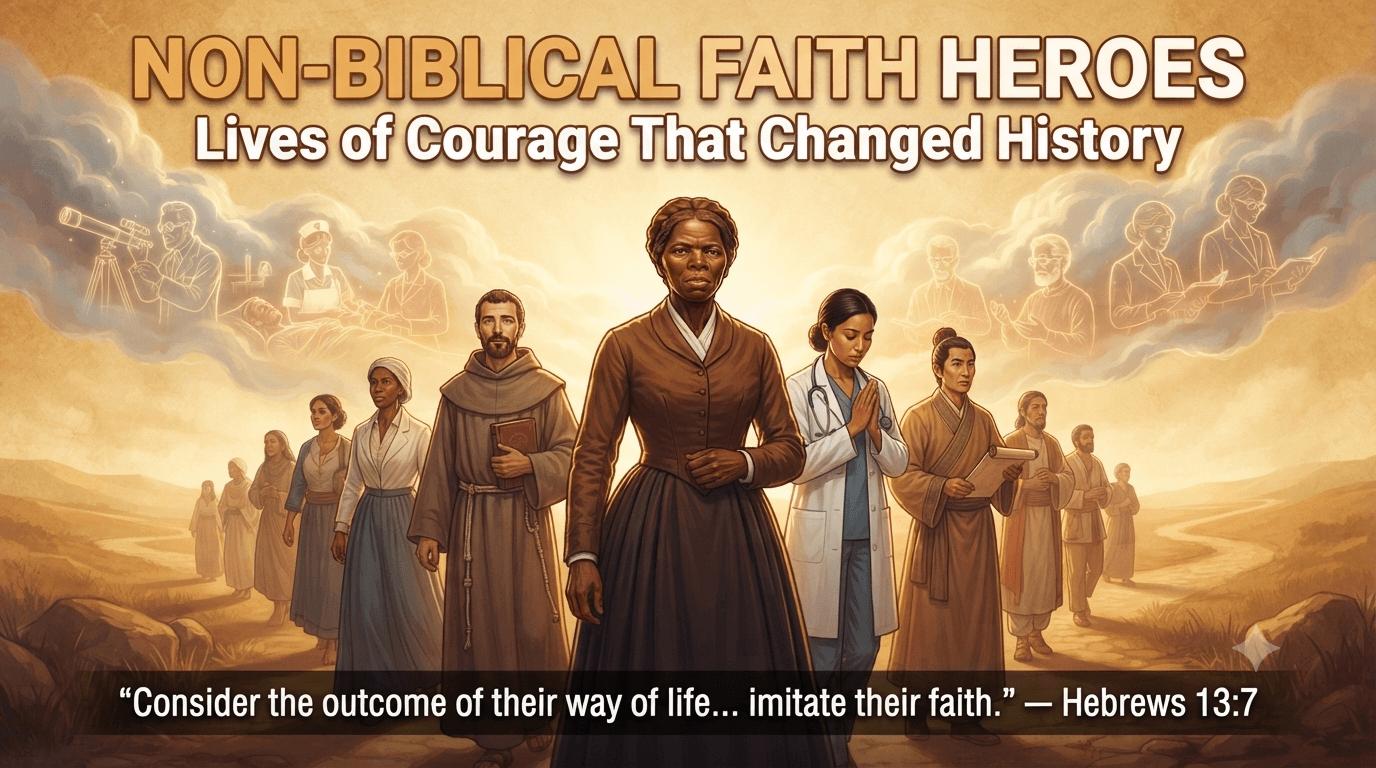
Non-Biblical Faith Heroes
Men and women across the centuries and continents who said YES to God — and changed the world through faith, prayer and obedience.
These are not perfect people — they are faithful people. Each one faced impossible circumstances, opposition and personal struggle. What they share is a surrendered life that God used for His glory. Their stories are not meant to be worshipped — they are meant to inspire. The Teacher is still the Holy Spirit. These lives are His classroom examples. ✝️
⚡ Jump to Any Person
Reinhard Bonnke
Reinhard Bonnke was born in Germany and felt called to Africa as a teenager. He founded Christ for All Nations (CfaN) in 1974 and began holding open-air gospel crusades across the African continent. Initially small, his meetings grew to staggering proportions — crowds of hundreds of thousands, then millions gathered to hear the gospel preached in football stadiums and open fields.
In Lagos, Nigeria in November 2000, Bonnke preached to an estimated 1.6 million people in a single service — one of the largest gatherings in Christian history. He estimated that over his lifetime 79 million people made documented decisions for Christ at his meetings. He preached his last crusade at age 78 and died peacefully in December 2019.
Bonnke taught that the gospel is the power of God unto salvation for every person without exception — that Africa was not a dark continent but a harvest field. His book Fire! Fire! and his autobiography Living a Life of Fire shaped a generation of evangelists. He believed deeply in the baptism of the Holy Spirit as equipment for evangelism.
Christ for All Nations continues his mission today under Daniel Kolenda. Bonnke's recorded sermons, training materials and evangelism resources have equipped hundreds of thousands of evangelists worldwide. He demonstrated that mass evangelism is still one of God's chosen tools for reaching the lost.
"Africa shall be saved!"
Billy Graham
William Franklin Graham Jr. grew up on a dairy farm in North Carolina and came to faith at 16 at an evangelistic meeting. After studying at Florida Bible Institute and Wheaton College, he began preaching with the organisation that became the Billy Graham Evangelistic Association in 1950. His 1949 Los Angeles crusade, extended from three weeks to eight, launched him to national prominence.
Over seven decades of ministry Graham preached in person to an estimated 215 million people in 185 countries and territories — more than any other individual in history. He met and counselled every US president from Harry Truman to Barack Obama. Through every decade and every temptation to compromise, he maintained a reputation for complete integrity and financial transparency that was never successfully challenged.
Graham preached a simple, direct gospel message centred on the cross of Christ and the necessity of personal decision. He was the first major evangelical leader to desegregate his crusades in the American South, refusing to hold meetings where Black and white attendees were separated. He championed racial reconciliation when it was deeply unpopular.
The Billy Graham Evangelistic Association estimates that more than 3.2 million people responded to the invitation to receive Christ at Graham's crusades. Countless world leaders, including many who came to faith, credit his influence. His integrity set a standard for Christian ministry that raised the credibility of the gospel in public life.
"I've read the last page of the Bible. It's all going to turn out all right."
Kathryn Kuhlman
Kathryn Kuhlman began preaching as a teenager in the American Midwest. After a painful personal chapter including a failed marriage she surrendered everything to God completely and began a healing ministry marked by extraordinary signs. She held weekly miracle services in Pittsburgh for years, then moved to Los Angeles, drawing thousands each week to witness remarkable documented healings.
What distinguished Kuhlman's ministry was her consistent deflection of all glory from herself. She insisted she had no gift of healing — that the Holy Spirit healed sovereignly and she was simply a yielded vessel. Doctors, scientists and journalists investigated the healings at her meetings and many were unable to find natural explanations. CBS filmed a documentary of her services which brought her ministry to a worldwide audience.
Kuhlman taught above all else the person and sovereignty of the Holy Spirit. Her book I Believe in Miracles documented many of the healings. Her greatest contribution was making the person of the Holy Spirit accessible and personal to millions who had never experienced His reality — she called Him the most real person she had ever known.
Her teaching series and books including I Believe in Miracles and God Can Do It Again are still in print and circulation. Benny Hinn credits her as the primary human influence on his understanding of the Holy Spirit. She demonstrated that deep dependence on the Holy Spirit produces more fruit than human ability or personality.
"I believe in miracles because I believe in God."
John G. Lake
John G. Lake was a successful businessman and insurance executive who walked away from a considerable fortune after a profound encounter with God and Zion City healing evangelist John Alexander Dowie. He sailed to South Africa in 1908 with his wife and seven children and no financial support, trusting God entirely. Over five years in South Africa he planted over 1,200 churches and saw remarkable healings.
During a devastating plague outbreak in South Africa, Lake and his co-workers ministered to the sick without protection while doctors fled. When asked how he could handle infected bodies without contracting the plague, Lake demonstrated his faith by asking a doctor to take live plague germs and place them on his palm under a microscope. The germs died on contact with his skin — which Lake attributed entirely to the power of the Holy Spirit operating through him.
Returning to the USA, Lake established Divine Healing Rooms in Spokane, Washington where he documented over 100,000 healings in five years. The US government declared Spokane the healthiest city in America during that period. Lake taught on divine health, the authority of the believer and the nature of healing as a legal right purchased by the atonement of Christ.
Lake's teachings on the authority of the believer, spiritual dominion and divine healing have profoundly influenced the charismatic and Word of Faith movements. His Healing Rooms model was revived in Spokane in 1999 and now operates in over 1,000 locations worldwide. He demonstrated that total dependence on God is practical, not theoretical.
"God intends every Christian to live in divine health."
Laxmibai Tilak
Laxmibai Sathe was born into a high-caste Hindu Brahmin family in Maharashtra. She was given in marriage to Narayan Vaman Tilak, a Brahmin scholar and poet. When her husband converted to Christianity she was initially devastated and opposed him bitterly. The thought of losing caste, family standing and social identity was overwhelming. But she watched her husband's transformed life and eventually came to faith herself — a decision that cost her dearly in terms of family and community rejection.
Laxmibai's conversion came at great personal cost. She wrote her autobiography Smriti Chitre — translated into English as I Follow After — which became one of the most remarkable accounts of conversion from high-caste Hinduism to Christ ever written. Her honest description of the social devastation that follows conversion in India, alongside the spiritual transformation she experienced, has touched generations of Indian Christians.
Laxmibai wrote poetry, hymns and literature in Marathi that gave Indian Christian women a voice at a time when women's voices were rarely heard. She worked alongside her husband in ministry and outlived him by seventeen years, continuing to serve the church. She demonstrated that the cost of the cross in India's caste system is real and that Christ is worth that cost.
Her autobiography remains in print and is considered a classic of Indian Christian literature. Laxmibai and her husband together represent the birth of an authentically Indian Christian witness — one that did not require abandoning Indian culture but transformed it from within. She is an inspiration to every Indian woman considering the cost of following Christ.
"I follow after — not because the way is easy, but because He who calls me is faithful."
Andrew Murray
Andrew Murray was born in South Africa to Scottish missionary parents and educated in Scotland and Holland before returning to South Africa as a Dutch Reformed minister. He pastored churches in remote frontier towns and later in larger congregations, including Worcester where a remarkable revival broke out in 1860 during which hundreds were converted and the Holy Spirit moved powerfully in ways that challenged Murray's own theological assumptions and deepened his understanding of God.
In 1879 Murray was struck with a throat ailment so severe that he could not speak for two years. During this enforced silence he wrote some of his most significant works on prayer and the spiritual life. When he emerged from this season he had been transformed — his earlier tendency toward striving had given way to a deep rest in God. Many considered the period of silence the making of his greatest contribution.
Murray wrote over 240 books and devotionals on prayer, holiness, the Holy Spirit and abiding in Christ. Works including With Christ in the School of Prayer, Abide in Christ, Humility and The Spirit of Christ have never gone out of print and continue to disciple millions. He wrote with precision, depth and practical application that makes profound truth accessible to ordinary believers.
Andrew Murray's books have sold tens of millions of copies and influenced virtually every stream of evangelical Christianity. His emphasis on humility, dependence and intercessory prayer shaped the spirituality of countless pastors, missionaries and ordinary believers across 150 years. He is one of the most widely read Christian authors in history.
"The man who mobilises the Christian church to pray will make the greatest contribution to world evangelisation in history."
Watchman Nee
Watchman Nee (Ni Tuosheng) was born in Fuzhou, China into a third-generation Christian family. He came to personal faith at eighteen under the preaching of Dora Yu and immediately began a life of intense Bible study, prayer and evangelism. Despite poor health throughout his life he planted churches across China, trained workers and wrote prolifically. He never sought a salary or financial security — he trusted God entirely for his needs while pouring himself into building the church in China during one of its most difficult periods, navigating both Japanese occupation and the rising Communist movement.
In 1952 the Chinese Communist government arrested Watchman Nee on fabricated charges. He was sentenced to fifteen years in prison, later extended. He spent the final twenty years of his life in prison and labour camps, refusing every offer of release that required him to renounce his faith or betray fellow believers. He died in a labour camp in 1972. A note found after his death read: "Christ is the Son of God who died for the redemption of sinners and resurrected after three days. This is the greatest truth in the universe. I die because of my belief in Christ." He was sixty-nine years old.
Watchman Nee's greatest contribution was his teaching on the believer's position in Christ — the revolutionary understanding that in Christ we are not trying to become something but learning to live from what we already are. His book The Normal Christian Life, based on Romans 1-8, is considered one of the clearest expositions of the believer's identity and life in the Spirit written in the twentieth century. Sit Walk Stand — a study of Ephesians — explains the Christian life in three postures: seated with Christ in heavenly places, walking worthy of that calling, and standing firm against spiritual opposition. His teaching gave countless believers a foundation that transformed their understanding of grace, identity and the Spirit-filled life.
Watchman Nee's books have been translated into dozens of languages and have sold millions of copies worldwide. His influence on Chinese Christianity in particular has been profound — many of the house church leaders who maintained the faith through decades of Communist persecution were shaped by his teaching and example. He demonstrated that biblical truth, faithfully taught and personally embodied, outlasts imprisonment, persecution and death. The church he built and trained survived everything the Communist government could do to destroy it.
"God is waiting to find someone whose heart is completely turned over to Him."
Derek Prince
Derek Prince was born in India to British parents and received a classical education at Eton and Cambridge, where he became a Fellow in Ancient and Modern Philosophy. As an atheist he began studying the Bible as a philosophical document and was dramatically converted in a British Army barracks in 1941. He was baptised in the Holy Spirit the same night and spoke in tongues, which he — as a professional linguist — recognised as a known human language he had not learned.
Prince served in the British Army in North Africa and then went to Palestine where he married his first wife Lydia, a Danish missionary who had established a home for orphaned girls in Jerusalem. Together they raised eight adopted daughters of different nationalities. After Lydia's death he married Ruth, a Jewish believer. His own journey through personal deliverance from depression shaped his subsequent teaching on spiritual warfare.
Derek Prince produced over 600 audio teachings and wrote over 80 books, many of which are considered definitive works on their subjects. His teaching on blessings and curses, spiritual warfare, the Holy Spirit, Israel and the church, and biblical foundations has provided some of the clearest and most scripturally precise teaching available in the contemporary church. He taught with the rigour of a Cambridge scholar and the warmth of a pastor.
Derek Prince Ministries continues his work in over 100 countries in over 60 languages. His teaching on the foundational doctrines of the Christian faith has been used to train pastors and church leaders across the world, particularly in regions where sound biblical teaching is scarce. He is widely considered one of the most reliable Bible teachers of the 20th century.
"The Bible is a supernatural book, written by a supernatural Being, about supernatural events, to produce supernatural results."
Nabeel Qureshi
Nabeel Qureshi grew up in a devout Ahmadiyya Muslim family in the United States. His parents raised him with deep love for Islam and rigorous apologetic training. At university he became close friends with Christian apologist David Wood, who challenged him intellectually about his faith. Over several years of intense study, debate and personal seeking, Nabeel examined the historical evidence for Christianity and Islam and found himself unable to deny the historical resurrection of Jesus.
Nabeel's conversion came at enormous personal cost — his family relationships were severely strained and his entire cultural identity was challenged. He documented this journey in his book Seeking Allah Finding Jesus (2014) which became a bestseller and is widely considered one of the most powerful accounts of Muslim-to-Christian conversion ever written. He pursued a medical degree and then theological studies at Oxford. In 2016 he was diagnosed with advanced stomach cancer and died in September 2017 aged 34.
Nabeel contributed a rare combination: the insider knowledge of a devout Muslim, the rigour of a medical and theological scholar, and the personal testimony of someone who had paid a real price for his faith. His books — including No God but One and Answering Jihad — equip Christians to engage respectfully and accurately with Islamic truth claims. He demonstrated that intellectual honesty and genuine seeking lead to Christ.
Though Nabeel died at 34 his impact has been extraordinary. His books continue to reach Muslims worldwide and his video series on Islam produced while he was receiving cancer treatment have been viewed millions of times. He is a particularly powerful voice for reaching South Asian Muslim communities. His death itself — faced with extraordinary faith and documented on social media — became a testimony.
"God is not looking for spiritual giants. He's looking for people who believe He is who He says He is."
Sadhu Sundar Singh
Sundar Singh was born into a wealthy Sikh family in the Punjab. Educated in Christianity and Hinduism alongside his Sikh faith, he grew to hate Christianity and was known to burn pages of the Bible. After his deeply beloved mother died his grief turned to rage and despair. On December 18 1904, aged fifteen, he knelt and told God that if He did not reveal Himself by morning he would throw himself under the train that passed his house at five. In the night Jesus appeared to him in a vision of light, speaking in Hindustani: How long will you persecute me? I gave my life for you. He rose from his knees a Christian.
His conversion devastated his family. He was disowned, turned out of his home and allegedly poisoned by a family member. He recovered and was baptised on his sixteenth birthday. Adopting the yellow robe of a Hindu Sadhu — a wandering holy man — he committed to carrying the gospel across India and into Tibet without money, home or security. He walked barefoot through the Himalayas into Tibet multiple times enduring imprisonment, attempted stoning and extreme hardship to bring the gospel to unreached peoples.
Sundar Singh taught that Christianity must be expressed in Indian forms — that the water of life could be given in an Indian cup. He was among the first to articulate what is now called contextualisation — presenting the gospel in culturally resonant ways without diluting its content. His mystical spirituality, shaped by years of prayer and suffering, produced a quality of insight into Christ that drew people from across the world to hear him speak.
Sundar Singh disappeared in 1929 on his final journey into Tibet, aged thirty-nine, and was never found. His life and writings continue to inspire Indian Christians and missionaries worldwide. He demonstrated that an authentically Indian Christianity is not only possible but powerfully effective. His story is one of the most remarkable in the history of Indian Christianity.
"There is no peace anywhere except in Jesus Christ."
Surprise Sithole
Surprise Sithole was born in a remote village in Mozambique into a family steeped in witchcraft and traditional religion. At fifteen he had a dramatic encounter with Jesus Christ that transformed him completely. He joined Heidi and Roland Baker of Iris Ministries and began evangelising in some of the most remote and dangerous parts of southern Africa — often walking for days to reach isolated villages.
Sithole and the Iris Ministries team have documented remarkable miracles in the bush of Mozambique and surrounding nations — the blind seeing, the deaf hearing and even accounts of the dead being raised, witnessed and documented by multiple credible observers including journalists and academics. His ministry has been characterised by simplicity, dependence on the Holy Spirit and willingness to go where no one else would go.
Sithole's autobiography Voice in the Night documents his journey from witchcraft to Christ and then into one of the most fruitful church-planting movements in Africa. He teaches that the power of God is available to the poorest, most ordinary believers — that signs and wonders follow those who simply obey and go. His life is evidence that Pentecost was not a one-time event.
Surprise Sithole has been involved in planting over 10,000 churches across southern Africa and has trained thousands of African church planters. His ministry demonstrates that revival is not dependent on wealth, education or infrastructure — only on obedience and the presence of God. He is one of the most significant figures in contemporary African Christianity.
"God does not call the qualified. He qualifies the called."
Narayan Vaman Tilak
Narayan Vaman Tilak was a gifted Marathi poet and scholar from a high-caste Brahmin background in Maharashtra. A fierce opponent of Christianity in his early years, he encountered a New Testament on a train journey in 1893 and was so struck by the Sermon on the Mount that he could not put it down. After years of inquiry he was baptised in 1895 — a decision that cost him his family, his caste and his social standing entirely. His wife Laxmibai initially opposed the conversion bitterly before herself coming to faith.
Tilak poured his considerable poetic gifts into composing hymns and devotional songs in Marathi that expressed Christian faith in genuinely Indian literary forms. He wrote over 700 hymns and poems and collaborated with missionary Justin Abbott on translating the Psalms into Marathi poetry. His composition Tukoba aani Mee (Tukaram and I) placed Christ within the tradition of the great Bhakti saints — a bold and beautiful contextualisation that made the faith accessible to ordinary Maharashtrians.
Tilak's greatest contribution was demonstrating that Indian culture and Christian faith are not incompatible — that the richest literary traditions of India can be filled with the content of the gospel. He resisted the tendency to make Indian Christianity a cultural copy of Western Christianity. He also pioneered the concept of the Kristopanishad — Christian teaching expressed in the form of the ancient Upanishads.
Narayan Vaman Tilak is considered the father of Marathi Christian literature and one of the most significant figures in the history of Indian Christianity. His hymns are still sung in Marathi churches across Maharashtra. Together with his wife Laxmibai he represents the gold standard of what an authentically Indian Christian witness can look like — rooted in Indian culture, transformed by Christ.
"I belong to the ragpicker Christ who gathered this rag of a life and made it something beautiful."
John Wesley
John Wesley was the fifteenth child of Samuel and Susanna Wesley, an Anglican rector and his remarkably gifted wife who personally educated all her children. Educated at Oxford where he and his brother Charles founded the Holy Club — a disciplined group of students so methodical in their faith they were mockingly called Methodists — Wesley was ordained an Anglican priest but sensed he lacked genuine saving faith. A failed missionary journey to Georgia confirmed his spiritual crisis. On May 24 1738 at a meeting in Aldersgate Street, London, while someone read Luther's preface to Romans, Wesley felt his heart strangely warmed and received the assurance of salvation.
What followed was one of the most astonishing ministries in church history. Excluded from Anglican pulpits because of his views, Wesley began preaching in the open air — first reluctantly, then with growing conviction that the fields were his parish. He preached an estimated 40,000 sermons over fifty years, travelling approximately 250,000 miles on horseback across Britain — the equivalent of circling the earth ten times. He preached until he was 87 years old.
Wesley taught salvation by grace through faith, the necessity of the new birth, and entire sanctification — the possibility of a heart so purified by God's love that sin no longer dominates it. He also translated conviction into action: he established schools, orphanages, medical dispensaries and credit unions for the poor. His campaign against slavery, launched when he was 83, planted seeds that bore fruit in the Abolitionist movement. His letter to William Wilberforce, written six days before his death, encouraged him to persist in the anti-slavery campaign.
Methodism grew from Wesley's ministry to encompass hundreds of millions of Christians across denominational lines. His social reforms — education for the poor, care for orphans, opposition to slavery — are credited with helping Britain avoid the kind of violent revolution that swept France. He demonstrated that genuine spiritual revival produces tangible social transformation.
"Do all the good you can, by all the means you can, in all the ways you can, in all the places you can, at all the times you can, to all the people you can, as long as ever you can."
Smith Wigglesworth
Smith Wigglesworth was born into poverty in Yorkshire, England and began working in factories at age six. He could neither read nor write until his wife Polly taught him to read using only the Bible. He worked as a plumber and began helping his wife in a small mission in Bradford. In 1907, at age 48, he travelled to Sunderland to investigate the Pentecostal revival taking place there and received the baptism of the Holy Spirit with speaking in tongues. His ministry was transformed overnight.
What followed was one of the most dramatic healing ministries in modern church history. Wigglesworth preached across Britain, Europe, America, Australia and beyond. Fourteen documented cases of people being raised from the dead were recorded in his ministry — including his own wife Polly who died suddenly and whom he commanded back to life before she finally went to be with the Lord twenty years later. He moved with a boldness toward sickness and disease that was sometimes startling — and regularly effective.
Wigglesworth taught that the Bible is the final authority on every question and that what God did in Acts He will do today for any believer who dares to believe it. His approach to healing was direct and authoritative — he saw sickness as an enemy to be confronted, not a trial to be accepted. His sermons, collected in books like Ever Increasing Faith and Faith That Prevails, remain powerful and practical.
Wigglesworth is considered one of the fathers of the modern Pentecostal and charismatic movements. He prophesied before his death in 1947 that a move of God would come that combined the Word and the Spirit — widely understood as a prophecy of the charismatic renewal of the 1960s-80s. His life demonstrated that complete illiteracy, poverty and late calling are no obstacle to extraordinary usefulness in God's hands.
"Only believe. Only believe. All things are possible — only believe."
Maria Woodworth-Etter
Maria Beulah Woodworth was born in Ohio and felt called to preach from an early age, but was told repeatedly that women could not be ministers. After losing five of her six children to illness and enduring a deeply painful marriage she finally responded to God's call and began preaching in 1880 despite intense opposition — both from those who rejected women preachers and from those who found her methods too extreme. She travelled by horse and wagon holding tent meetings across America.
Woodworth-Etter's meetings were marked by extraordinary supernatural manifestations — people falling under the power of God and lying motionless for hours, blind eyes opening, deaf ears unstopped and tumours disappearing. In 1904 she held campaigns in several cities where the crowds were so large and the Spirit's movement so powerful that people were allegedly overcome by the Spirit while still outside the tent before reaching the meeting. Sceptics came to expose fraud and many were converted instead.
She taught that the gifts of the Holy Spirit described in 1 Corinthians 12 are available to every believer and were not withdrawn at the end of the apostolic age. Her book Signs and Wonders documented her ministry and became a foundational text for early Pentecostalism. She was one of the first women to publicly practice and teach on spiritual gifts in the modern era at a time when this was deeply countercultural.
Maria Woodworth-Etter is widely considered a pioneer of the modern Pentecostal movement, which formally began in 1906 at Azusa Street — a revival she had prophesied. Several key Azusa Street participants had previously attended her meetings. She demonstrated that God uses women powerfully in ministry and that the Holy Spirit does not confine Himself to conventional church services.
"God is still in the miracle-working business — what He did before He will do again."
✝️ Non-Biblical Faith Heroes · charlenz.shop
A Faith Library — Blessing Nations and Generations ✝️
These are not the only heroes — there are thousands more written in the Lamb's Book of Life. · ask@charlenz.shop
Support This Ministry
"Each one must give as he has decided in his heart,
not reluctantly or under compulsion,
for God loves a cheerful giver."
— 2 Corinthians 9:7 ✝️
Choose an amount
 Donate $10 via PayPal
🔒 Secured by PayPal · Accepts Visa · Mastercard · Amex · Bank Transfer · 200+ countries
Choose an amount
🔒 Secured by Razorpay · UPI · Cards · Net Banking · EMI · Wallets
"Nevertheless, you who have been trained in the word should share all good things with their trainer." — Galatians 6:6 ✝️
Website Copyright Notice — Applicable to All Content on charlenz.shop
© Joyce Braganza · Tree of Life Deliverance Ministry · charlenz.shop · All Rights Reserved.
All content on this website — including Bible studies, games, quizzes, prayers, praises, prophecies, family trees, concordances, devotionals, articles, books, downloads, graphics, illustrations, designs, calendars, planners, templates and all written material — is the intellectual property of Joyce Braganza and Tree of Life Deliverance Ministry, unless otherwise stated. This content is made available solely for personal, non-commercial and devotional use only.
🚫 Not permitted without prior written permission: Copying . Reproduction · Redistribution · Republication · Sale · Commercial use · Adaptation · Translation · AI training · Data scraping · Digital storage for redistribution · Publication in any format · Distribution via any medium.
Unauthorized reproduction, distribution, republication, adaptation, or commercial use of any part of this website may constitute copyright infringement and may result in legal action.
✅ Permitted: Personal reading · Sharing the page URL · Printing for personal use · Brief quotations with full attribution to charlenz.shop.
📧 For permissions, translations or print enquiries: ask@charlenz.shop ·
"A faithful person will be richly blessed." — Proverbs 28:20 ✝️